Wednesday, January 12, 2022


Thursday, January 6, 2022
SILENT CINEMA : various movements
OVERVIEW
Brief article on 1920s cinema
TIMELINE OF SILENT CINEMA
MAIN AREAS OF FOCUS
How Keaton's short films fit into and can be contrasted with the history, social contexts, development and the various movements ( as well as within silent comedy) in early and silent film , including expressive v realist styles of filmmaking .
REALIST:
Film should be rooted in reality and shot and edited to match reality as closely as possible for the audieence. The director should be as invisible as possible. ( Andre Bazin)
Meaning is created within the frame by the image itself , not through editing or cuts.
LUMIERE EARLY SHORT FILMS ( 1895)
"The Cinema of attractions " which focused on audience sensation and immediate experience rather than any narrative elements was a major element of early cinema.
" The arrival of a train at a station " ( Lumiere 1895)
short biography
Although formalist techniques like editing and range of shot types are used , "realist" films focused on characters, issues and narratives closely connected with everyday life rather than escapism . They tend to be straightforwardly shot with minimal use of stylish or distracting editing techniques. Use of cartoon gags or breaking the fourth wall would never be used in such "realist" movements.
EXPRESSIVE :
Films focus more on the use and manipulation of film form elements such as editing and mise-en-scene as well as the image to suggest meaning for the audience. Fantasy, escapist entertainment, creating fictional narrative and manipulation of the audience are key elements.
Brief overview
Range of genres
Brief article on 1920s cinema
TIMELINE OF SILENT CINEMA
MAIN AREAS OF FOCUS
How Keaton's short films fit into and can be contrasted with the history, social contexts, development and the various movements ( as well as within silent comedy) in early and silent film , including expressive v realist styles of filmmaking .
REALIST:
Film should be rooted in reality and shot and edited to match reality as closely as possible for the audieence. The director should be as invisible as possible. ( Andre Bazin)
Meaning is created within the frame by the image itself , not through editing or cuts.
LUMIERE EARLY SHORT FILMS ( 1895)
"The Cinema of attractions " which focused on audience sensation and immediate experience rather than any narrative elements was a major element of early cinema.
" The arrival of a train at a station " ( Lumiere 1895)
short biography
Although formalist techniques like editing and range of shot types are used , "realist" films focused on characters, issues and narratives closely connected with everyday life rather than escapism . They tend to be straightforwardly shot with minimal use of stylish or distracting editing techniques. Use of cartoon gags or breaking the fourth wall would never be used in such "realist" movements.
EXPRESSIVE :
Films focus more on the use and manipulation of film form elements such as editing and mise-en-scene as well as the image to suggest meaning for the audience. Fantasy, escapist entertainment, creating fictional narrative and manipulation of the audience are key elements.
Essentially this is mainstream narrative and auteur-led cinema cinema , where the director is more concerned with expressing subjective experience than objective reality. This leads to filmmakers developing their own individual aesthetic and creative signature and the extensive manipulation of audience response through creative and stylised "anti-realist" use of film form such as extensive or intrusive editing, extreme and symbolic use of lighting and colour and creative use of diegetic/non-diegetic sound.
Expressive cinema can also refer to genres and narrative that are less concerned with everyday life and ordinary reality such as science fiction, fantasy and surrealistic dramas.
An early example of expressive escapist anti-realist filmmaking with manipulation of mise-en-scene was Melies' Trip to the Moon ( 1902)
Other expressive film movements of the time you may want to compare silent comedy to include the following :
T
Soviet montage theory ( a modern explanation )
Meaning is created through editing and cuts.
An example of montage in action in narrative cinema
from Battleship Potemkin ( Eisenstein 1925 )
German expressionism e.g Nosferatu ( Murnau 1922) ,
Sunrise, (Murnau 1927) defined : another expressive film movement of the 1920s ( and 1930s ) that helps you put Silent Comedy in context .
BAND 5 5 TIP :
One ideological issue with the development of narrative cinema and expressive film could be be that films could be used to express some unpleasant ideas and ideologies to an audience not used to the manipulative techniques of film. For example , D.W Griffith's 1915 film Birth of a Nation was technically and narratively progressive but expressed racist beliefs and the representation of the KKK as the heroes and saviours of America.
The short films of Buster Keaton fall within the expressive category and use elements
such as montage editing to create meaning. However Keaton liked to show his jokes visually within the frame and create as much meaning as possible for the audience in the frame rather than simply relying on cuts, so there are links in his work to "realism". He can also be described as bridging the two worlds of early " Cinema of attractions" ( in his set pieces and cartoon gags ) and narrative cinema. It's also worth remembering that comedy tends to use techniques like breaking the fourth wall and breaking the rules of the" realistic" world more than other more "serious" genres.
Expressive cinema can also refer to genres and narrative that are less concerned with everyday life and ordinary reality such as science fiction, fantasy and surrealistic dramas.
An early example of expressive escapist anti-realist filmmaking with manipulation of mise-en-scene was Melies' Trip to the Moon ( 1902)
Other expressive film movements of the time you may want to compare silent comedy to include the following :
T
Soviet montage theory ( a modern explanation )
Meaning is created through editing and cuts.
An example of montage in action in narrative cinema
from Battleship Potemkin ( Eisenstein 1925 )
German expressionism e.g Nosferatu ( Murnau 1922) ,
Sunrise, (Murnau 1927) defined : another expressive film movement of the 1920s ( and 1930s ) that helps you put Silent Comedy in context .
Top 10 narrative films of the 1920s (includes some mentioned above)
One ideological issue with the development of narrative cinema and expressive film could be be that films could be used to express some unpleasant ideas and ideologies to an audience not used to the manipulative techniques of film. For example , D.W Griffith's 1915 film Birth of a Nation was technically and narratively progressive but expressed racist beliefs and the representation of the KKK as the heroes and saviours of America.
The short films of Buster Keaton fall within the expressive category and use elements
such as montage editing to create meaning. However Keaton liked to show his jokes visually within the frame and create as much meaning as possible for the audience in the frame rather than simply relying on cuts, so there are links in his work to "realism". He can also be described as bridging the two worlds of early " Cinema of attractions" ( in his set pieces and cartoon gags ) and narrative cinema. It's also worth remembering that comedy tends to use techniques like breaking the fourth wall and breaking the rules of the" realistic" world more than other more "serious" genres.
Wednesday, December 15, 2021
FILM MOVEMENT : SILENT FILM COMEDY
Silent film comedy was a very popular genre in the silent era ( 1895-1928 ) in the USA and UK
It still exists as an art form in the modern era and has influenced much modern physical and visual comedy.
Silent comedy is predominantly based on physical and visual gags and jokes
with occasional written puns and jokes in the title cards.
It was heavily influenced by the broad "slapstick " humour of the popular vaudeville theatre of the 19th century ( where Buster Keaton started) and included standard routines such a "custard pie in the face " , " tripping on banana peel " as well as much comedy physical violence and acrobatics.
Buster Keaton's work in his early short films was in many ways typical of silent comedy : the influence of vaudeville, the use of slapstick, the representatation of police, the use of personae such as the outsider, everyman or romantic suitor, and the modernist use of formal and technical experimentation .
Keaton's deadpan persona was his unique selling point and he stands out in silent comedy for his careful and precise use of framing, his general refusal to repeat jokes and falls and his general refusal to fake stunts and physical jokes through editing : Keaton usually allows his jokes to take place within the frame rather than cutting.


One of the major contributions of American popular cinema to European art cinema, especially in the Soviet Union, was Silent Comedy. American Silent Comedy produced a significant body of work, now regarded as of great importance in film history. The key exponents of this movement (Chaplin, Keaton, Lloyd) all knew each other, influenced each other’s work and were always experimental, pushing at the boundaries of film form and film technology. In particular American Silent Comedy further illustrates the preoccupation with modernism in the film movements of this period. In this latter case this can be seen in a similar interest to the Soviet constructivists in the machinery of cinema and the mechanics of acting. Just as German Expressionism was repeatedly engaging with genre cinema, so American Silent Comedy marries formal experimentation from popular culture, in particular vaudeville, exploiting the possibilities of cutting edge cinema technology available in Southern California in the 1920s. It is possible to place American Silent Comedy in the wider frame of the 1920s avant-garde, with particular connections to the emerging art forms of Dadaism and Surrealism in Europe, as well as its strong impact on Eisenstein and others in the Soviet Union.
KEY PRODUCERS
Mack Sennett
Hal Roach
KEY STARS
Buster Keaton
Charlie Chaplin
The Keystone Cops
Harold Lloyd
The narratives in silent comedy often developed in length and complexity from 1910s onwards as the films became longer : one reel films of about 10 minutes developed into feature length 3-4 reelers of 40+ minutes and longer.
Keaton's 20-minute 2 reel shorts of the early 1920s form a part of this process.
During this time cinematic, narrative and genre conventions, editing techniques , technical methods and other uses of film form were being developed alongside changing audience expectations and understanding of narrative cinema.
The invention of sound in cinema in 1927/8 meant that original silent comedy became less popular and was generally phased out in the industry but its influence on modern film comedy and action remains. The conventions of physical and verbal humour established in the silent era can still be seen in a range of filmmakers and stars.
LINKS
Paul Merton's film about early screen comedy is good at its origins and early technology and conventions and key early figures like Max Linder
Merton's documentaries about the key stars of the silent era ( including Buster Keaton )
Context of silent comedy in history of film comedy
The wikipedia page for silent comedy is an ok starting point for some background information.
It still exists as an art form in the modern era and has influenced much modern physical and visual comedy.
Silent comedy is predominantly based on physical and visual gags and jokes
with occasional written puns and jokes in the title cards.
It was heavily influenced by the broad "slapstick " humour of the popular vaudeville theatre of the 19th century ( where Buster Keaton started) and included standard routines such a "custard pie in the face " , " tripping on banana peel " as well as much comedy physical violence and acrobatics.
Buster Keaton's work in his early short films was in many ways typical of silent comedy : the influence of vaudeville, the use of slapstick, the representatation of police, the use of personae such as the outsider, everyman or romantic suitor, and the modernist use of formal and technical experimentation .
Keaton's deadpan persona was his unique selling point and he stands out in silent comedy for his careful and precise use of framing, his general refusal to repeat jokes and falls and his general refusal to fake stunts and physical jokes through editing : Keaton usually allows his jokes to take place within the frame rather than cutting.


One of the major contributions of American popular cinema to European art cinema, especially in the Soviet Union, was Silent Comedy. American Silent Comedy produced a significant body of work, now regarded as of great importance in film history. The key exponents of this movement (Chaplin, Keaton, Lloyd) all knew each other, influenced each other’s work and were always experimental, pushing at the boundaries of film form and film technology. In particular American Silent Comedy further illustrates the preoccupation with modernism in the film movements of this period. In this latter case this can be seen in a similar interest to the Soviet constructivists in the machinery of cinema and the mechanics of acting. Just as German Expressionism was repeatedly engaging with genre cinema, so American Silent Comedy marries formal experimentation from popular culture, in particular vaudeville, exploiting the possibilities of cutting edge cinema technology available in Southern California in the 1920s. It is possible to place American Silent Comedy in the wider frame of the 1920s avant-garde, with particular connections to the emerging art forms of Dadaism and Surrealism in Europe, as well as its strong impact on Eisenstein and others in the Soviet Union.
KEY PRODUCERS
Mack Sennett
Hal Roach
KEY STARS
Buster Keaton
Charlie Chaplin
The Keystone Cops
Harold Lloyd
The narratives in silent comedy often developed in length and complexity from 1910s onwards as the films became longer : one reel films of about 10 minutes developed into feature length 3-4 reelers of 40+ minutes and longer.
Keaton's 20-minute 2 reel shorts of the early 1920s form a part of this process.
During this time cinematic, narrative and genre conventions, editing techniques , technical methods and other uses of film form were being developed alongside changing audience expectations and understanding of narrative cinema.
The invention of sound in cinema in 1927/8 meant that original silent comedy became less popular and was generally phased out in the industry but its influence on modern film comedy and action remains. The conventions of physical and verbal humour established in the silent era can still be seen in a range of filmmakers and stars.
LINKS
Paul Merton's film about early screen comedy is good at its origins and early technology and conventions and key early figures like Max Linder
Merton's documentaries about the key stars of the silent era ( including Buster Keaton )
Context of silent comedy in history of film comedy
The wikipedia page for silent comedy is an ok starting point for some background information.
Tuesday, December 7, 2021
OVERVIEW :Buster Keaton
video essay 1
His flexible and layered persona included the following elements and recurring motifs :
• Deadpan humour and neutral expression• Acrobatic skill and heavy use of stuntwork.
• Interactions with physical objects and locations ( sometimes skilled,occasionally clumsy)
He developed a combination of various personae :
The outsider clown , not integrated in or subject to the rules of everyday society or underworlds
The everyman trying to join in or get ahead•
The suitor : Seeking a soulmate and competing for a woman's attentions
• Interactions with physical objects and locations ( sometimes skilled,occasionally clumsy)
He developed a combination of various personae :
The outsider clown , not integrated in or subject to the rules of everyday society or underworlds
The everyman trying to join in or get ahead•
The suitor : Seeking a soulmate and competing for a woman's attentions

article on his persona and work, with a focus on Cops
YOUTUBE PLAYLIST OF VIDEOS ( Buster Keaton ,silent cinema, contexts.,issues and debates)
Other scenes from other films
Car on train tracks ( Parlor,bedroom and bath 1931)
Dream scene from Sherlock Jr (1924)
Motorcycle chase from Sherlock Jr
Buster Keaton wikipedia
THE SHORT FILMS
Here are the texts for the Silent Film section of the exam :
One Week ( 1920)

The Scarecrow ( 1921)

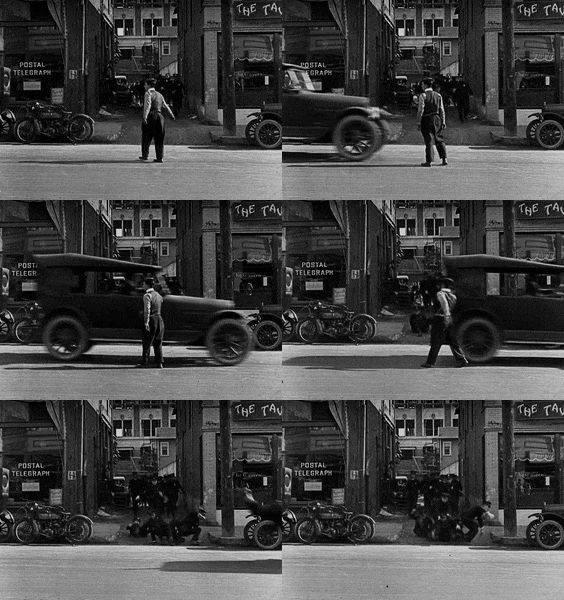
KEY ANALYSIS OF THE SHORT FILMS
Buster Keaton's film persona
e.g aspirational everyman, romantic suitor or outsider clown , links to performance
Representations
e.g gender roles , police, class, social institutions/rituals such as marriage and religion
General Silent comedy conventions
e.g use of stunts, chase scenes , falls, props, animals , slapstick humour, vaudeville tropes and routines e.g banana peel
Cultural contexts and references
e.g advertising, art , technologies, vaudeville, political and news events


article about 'One Week'
blog review of some of the short films
film essay on 'The High Sign '
One Week ( 1920)

In 2008, One Week was selected for preservation in the United States National Film Registry by the Library of Congress as being "culturally, historically, or aesthetically significant".
The Scarecrow ( 1921)

KEY ANALYSIS OF THE SHORT FILMS
How do each of the short films apply the following elements ?
Use of Film Form
use of cinematography ,lighting and framing : e.g framing to fit the joke, use of 2d , naturalistic bright lighting
use of cinematography ,lighting and framing : e.g framing to fit the joke, use of 2d , naturalistic bright lighting
style of editing ( invisible/when necessary ) , use of cuts and special effects,
use and role of mise-en-scene, e.g props and background used actively as part of narrative and jokes
performance ( body language, facial expression , size and contrast in physique )
Buster Keaton's film persona
e.g aspirational everyman, romantic suitor or outsider clown , links to performance
Representations
e.g gender roles , police, class, social institutions/rituals such as marriage and religion
General Silent comedy conventions
e.g use of stunts, chase scenes , falls, props, animals , slapstick humour, vaudeville tropes and routines e.g banana peel
Keaton's specific use of conventions and techniques
"postmodern" techniques such as breaking fourth wall , cartoon gags , layering and building of jokes, subverting classic vaudeville routines and expectations, interest in technology/media
Cultural contexts and references
e.g advertising, art , technologies, vaudeville, political and news events


article about 'One Week'
blog review of some of the short films
film essay on 'The High Sign '
Friday, December 3, 2021
SILENT CINEMA : Star persona of the 1920s
•Film
studios would create personas for actors and actresses, crafting a celebrity image for each performer – they created regulations such as morality clauses
and built gender stereotypes into their persona.
Guardian article on silent era film stars
Guardian article on silent era film stars
•This
was a precursor to the emergence of the Studio System with Hollywoodland
dominating cinema with its use of vertical integration from 1930s-1960.
•Buster
Keaton bypassed this by having creative control on his productions (not just an
actor, but producer, writer and director as well) – essentially, Keaton crafted
his own persona.

His flexible and layered persona included the following elements and recurring motifs :
• Deadpan humour and neutral expression• Acrobatic skill and heavy use of stuntwork.
• Interactions with physical objects and locations ( sometimes skilled,occasionally clumsy)
He developed a combination of various personae :
The outsider clown , not integrated in or subject to the rules of everyday society or underworlds•
The everyman trying to join in or get ahead•
The suitor : Seeking a soulmate and competing for a woman's attentions
• Interactions with physical objects and locations ( sometimes skilled,occasionally clumsy)
He developed a combination of various personae :
The outsider clown , not integrated in or subject to the rules of everyday society or underworlds•
The everyman trying to join in or get ahead•
The suitor : Seeking a soulmate and competing for a woman's attentions
.
Wednesday, December 1, 2021
SILENT COMEDY : Cultural contexts
Cultural contexts : other art forms and movements, Keaton's background and own influences, new technologies , social roles and expectations, wider social events,contexts and representations.... and their impact on the texts , genre, filmmaking process . audience experience , knowledge and expectations.


FURTHER LINKS
VAUDEVILLE wiki
Rube Goldberg ( 1920s cartoonist ) wiki
Ford 's prefabricated homes ( 1919 video)
CUBISM : Definition
SURREALISM : Definition
Buster Keaton was admired by the surrealistic art movement : academic article
Wednesday, November 10, 2021
EXAM QUESTION EXAMPLE 1
Discuss how far your chosen film or films reflect cultural contexts associated with a particular film movement
( 20 marks ) 30 minutes approx
FILM MOVEMENT = SILENT COMEDY
CHOSEN FILMS = 4 short films by Buster Keaton You should make reference to at least two of the films if it is this type of question
CULTURAL CONTEXTS = can include the history and conventions of the film movement iteself ( i.e silent comedy , social and historical factors, the influence of vaudeville, the influence of art and cultural movements e.g surrealism, modernism. DON"T FEEL YOU HAVE TO COVER EVERYTHING
PARTICULAR SEQUENCE = an extended scene ( ideally in one location ) This can be up to 10 minutes approximately so may be half of the short film . You should briefly make it clear where the scene fits in the film's narrative
e.g One week : building a house sequence, destroying a house sequence etc.
The Scarecrow : the multipurpose room sequence, the dog chase sequence, etc.
Cops : police chase sequence
The High Sign : shooting gallery sequence , assassination/ action chase sequence
YOU SHOULD INCLUDE ANALYSIS OF AT LEAST TWO OF THE SHORT FILMS IN YOUR ANSWER , UNLESS YOU ARE ASKED TO FOCUS ON A SINGLE KEY SEQUENCE.
Wednesday, October 2, 2019
CRITICAL DEBATE realist v expressionist cinema
REALIST CINEMA :
The relationship of film to reality has always been one of the main discussion points in cinema since the 189os and early 1900s. Consider the Lumiere Brothers ultrarealist short films vs Melies' fantasy narratives such as Trip to the Moon
There is no single formal definition of what a "realist " film is : it can refer to the narrative showing realistic or everyday events or the use of film form being simple,unadorned and stylistically straightforward ( as we would see it in life). Bazin's definition below is the starting point and basis for how you should be exploring realism in your answer.
"Film should be rooted in reality and shot and edited to match reality as closely as possible for the audience. The director should be as invisible as possible."
The relationship of film to reality has always been one of the main discussion points in cinema since the 189os and early 1900s. Consider the Lumiere Brothers ultrarealist short films vs Melies' fantasy narratives such as Trip to the Moon
There is no single formal definition of what a "realist " film is : it can refer to the narrative showing realistic or everyday events or the use of film form being simple,unadorned and stylistically straightforward ( as we would see it in life). Bazin's definition below is the starting point and basis for how you should be exploring realism in your answer.
"Film should be rooted in reality and shot and edited to match reality as closely as possible for the audience. The director should be as invisible as possible."
( Andre Bazin )
Film form was described by Bazin as realistic when it focused on the image itself and did not manipulate the audience through cuts or changes of camera angle. This is an extreme definition of realism in film but it can easily be applied to silent cinema and Keaton.
The concentration on objective reality, deep focus, and lack of montage are linked to Bazin's belief that the interpretation of a film or scene should be left to the spectator.
This placed him in opposition to film theory of the 1920s and 1930s and expressionist ideas of film, which emphasized how the cinema could manipulate reality.
"Realism" is also linked to genres that focuses on the drama of ordinary life such as drama and it can also refer to the depiction of real events and is often used to describe documentary.
LINK to further theories and discussions
EXPRESSIVE CINEMA:
Essentially this is mainstream narrative and auteur-led cinema cinema , where the director is more concerned with expressing subjective experience than objective reality. This leads to filmmakers developing their own individual aesthetic and creative signature and the extensive manipulation of audience response through creative and stylised "anti-realist" use of film form such as extensive or intrusive editing, extreme and symbolic use of lighting and colour and creative use of diegetic/non-diegetic sound.
Expressive cinema can also refer to genres and narrative that are less concerned with everyday life and ordinary reality such as science fiction, fantasy and surrealistic dramas.
KEY QUESTION : Does Keaton show realistic and everyday events in a simple unadorned "realistic" way ? Or is he simply an expressionist filmmaker ?
Consider his creative signature , his use of framing and editing , his use of silent comedy conventions such as stunts and slapstick, his use of documentary and real footage, his exaggerated setpiece scenes such as chases, the "reality" of his stunt work, his use of impossible "cartoon" gags, the themes and narratives of the short films, the emotional content and uses of persona, the settings and the chains of cause and effect in his work.
EXAMINERS REPORT Summer 2019 Q 3.2
"Realism" is also linked to genres that focuses on the drama of ordinary life such as drama and it can also refer to the depiction of real events and is often used to describe documentary.
LINK to further theories and discussions
EXPRESSIVE CINEMA:
Essentially this is mainstream narrative and auteur-led cinema cinema , where the director is more concerned with expressing subjective experience than objective reality. This leads to filmmakers developing their own individual aesthetic and creative signature and the extensive manipulation of audience response through creative and stylised "anti-realist" use of film form such as extensive or intrusive editing, extreme and symbolic use of lighting and colour and creative use of diegetic/non-diegetic sound.
Expressive cinema can also refer to genres and narrative that are less concerned with everyday life and ordinary reality such as science fiction, fantasy and surrealistic dramas.
KEY QUESTION : Does Keaton show realistic and everyday events in a simple unadorned "realistic" way ? Or is he simply an expressionist filmmaker ?
Consider his creative signature , his use of framing and editing , his use of silent comedy conventions such as stunts and slapstick, his use of documentary and real footage, his exaggerated setpiece scenes such as chases, the "reality" of his stunt work, his use of impossible "cartoon" gags, the themes and narratives of the short films, the emotional content and uses of persona, the settings and the chains of cause and effect in his work.
EXAMINERS REPORT Summer 2019 Q 3.2
Identifying expressionist feature was
not difficult for nearly all candidates, even in the case of the Keaton Shorts about
which more will be said in a moment. The challenge came in the identification of
realism and it is here that more work could focus for future years.
Some candidates identified realism in relation to ‘true to life’ so unlikely occurrence
fell outside this working definition. This was not very productive. Some identified
realism in terms of photographic realism, including the lack of distortion or special
effects. This led to some interesting exploration.
Very few
related an understanding of realism to Bazin’s argument which is the stated
theoretical underpinning for this topic.
Keaton’s Shorts proved to be both a popular choice and surprisingly well suited to the
question. Candidates were able to think through the extent to which Keaton’s
unadorned photographic representation of what was in front of the camera was
‘realism’ even if some of the things caught on camera were completely crazy. Many
candidates introduced a third term to the discussion – surrealism while the house in
One Week was described as cubist.
Overall, what was so good about work in response to this question was that
candidates were thinking, actively working out an argument. Examiners rewarded this
engagement even if some of the arguments and or examples were somewhat
contentious.
It is expected that when close study of a sequence is asked
for, then one sequence from one film is sufficient. This means that candidates did not
have to offer a sequence from Man With a Movie Camera and from A Propos de
Nice, either would have sufficed. The same applies to the Keaton Shorts although here candidates were actually
advantaged by referring to more than one of the shorts in answering 3.2 as the
balance of realist / expressionist features varies across the four.
Tuesday, January 8, 2019
Subscribe to:
Posts (Atom)